I tasted the blood before I tasted the soup.
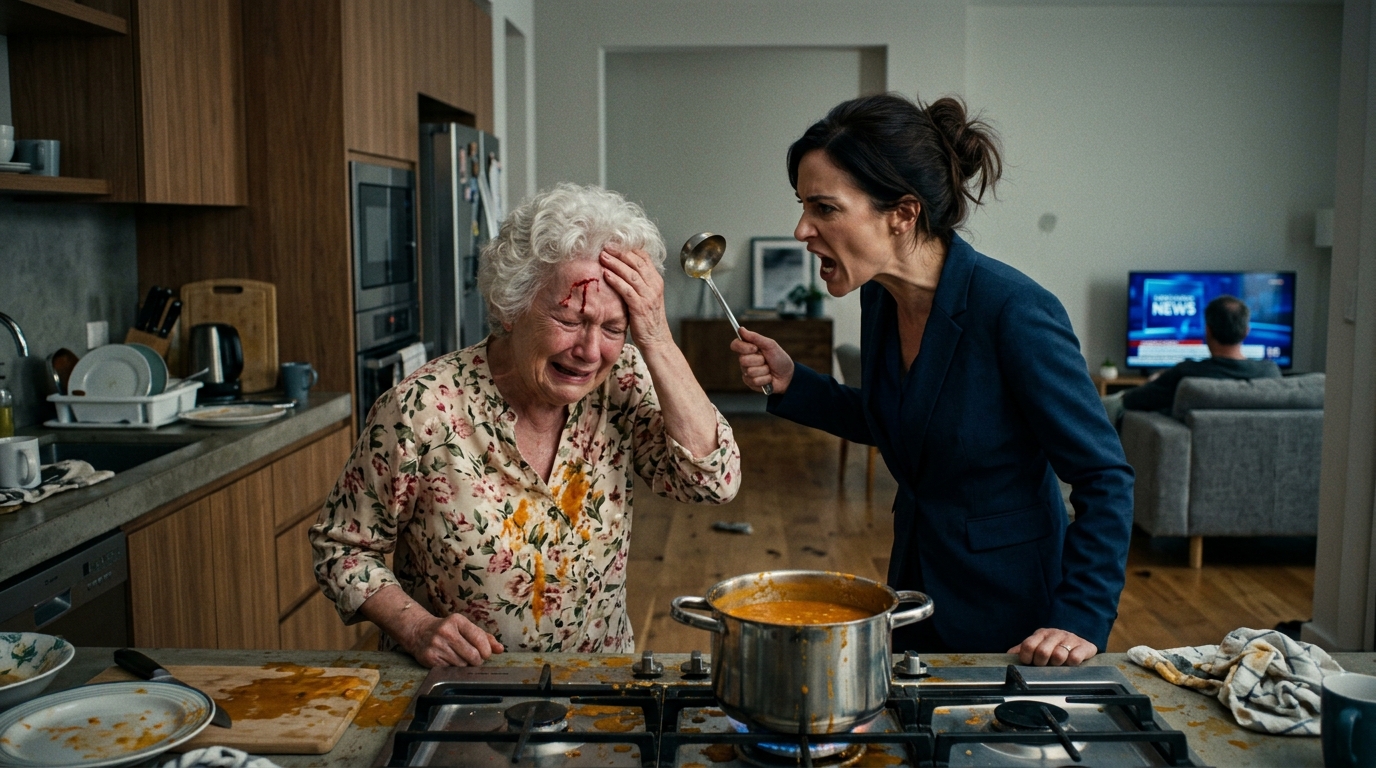
It was warm, metallic, and profoundly wrong, sliding down the side of my face in a slow, thick rivulet. Chicken broth—the kind I had simmered low and slow for six hours, the way my own mother taught me—dripped from my graying hair onto the immaculate, imported Italian tile of Dawn’s kitchen.
One second, I had been standing over the stove, stirring the heavy cast-iron pot with the rhythmic, hypnotic motion I had used for fifty years. The kitchen smelled of rosemary, thyme, and the quiet comfort of a Sunday evening. The next second, the world fractured in a blinding flash of white light.
My daughter-in-law, Dawn, had taken the heavy iron serving spoon resting on the counter and slammed it against my temple. She hit me so hard my knees buckled, sending a shockwave of pain down my jaw and into my teeth.
“You useless old hag!” Dawn shouted. Her voice didn’t waver; it was sharp enough to score glass. “How dare you poison us?”
The spoon clattered to the floor, ringing out like a cracked bell, but not before she had pointed it at me like a weapon. I blinked, trying to clear the sudden blur in my vision. Her designer cashmere sweater was still perfect. Her crimson lipstick was untouched. She stood there, chest heaving slightly, looking exactly as she always did: immaculate, expensive, and furious. It was as if she hadn’t just split open the side of an old woman’s head over a broth she deemed a fraction too salty.
I pressed my trembling hand to my temple. When I pulled it away, I saw brilliant, vivid red blooming across my palm, staining the deep lines of my skin. My first instinct, strangely, was not anger. It wasn’t even fear. It was a hollow, echoing disbelief. At seventy-one, after raising a boy entirely on my own, after decades of quiet sacrifice and backbreaking labor, I simply could not fathom that this was the sum total of my life.
I turned slowly, my balance slightly off, looking past the granite island and into the open-plan living room.
“Michael,” I whispered. My voice sounded thin, like dry leaves scraping across pavement.
My son sat on the oversized leather sectional, the television remote resting casually in his hand. He was staring at the glowing screen—some meaningless sports commentary—as if the violence in the kitchen were nothing more than the drone of traffic outside. Dawn had married him seven years earlier, and I had watched, year by year, as every trace of warmth, every ounce of the gentle boy I once knew, had been systematically eroded.
He looked at me then. He really looked at me, taking in the blood dripping onto my collar, the shaking of my shoulders. The look in his eyes wasn’t concern. It was the absolute, hollow coldness I had only ever seen in the eyes of strangers on the subway.
“Don’t start, Mom,” he said flatly, returning his gaze to the TV.
“Your mother ruined dinner,” Dawn snapped, crossing her arms. She stepped carefully around the spilled broth on the floor, protecting her suede loafers. “Again.”
I was shaking violently now, a mix of adrenaline and a deep, freezing sorrow. Broth and blood were soaking into the collar of my favorite cotton blouse. “I didn’t ruin anything. It was an accident. It’s just salt, Dawn.”
Dawn let out a short, bitter laugh that echoed off the high ceilings. “Everything with you is an accident, Helen. The electric bill. The groceries. The hot water. You eat, you sleep, you pretend to help fold the laundry, and we’re supposed to fall to our knees in gratitude?”
I stared at her, the throbbing in my head syncing with my heartbeat. The electric bill? The groceries? This was the Elm Street Cooperative. It was a premium building in the heart of the city. I knew exactly what the electric bill was, because it was drawn from an account I funded. The property taxes, the quarterly maintenance fees, the doorman’s Christmas bonus, even the abhorrently expensive marble countertop Dawn constantly bragged about to her tennis club friends—none of it, not a single cent, came from Michael’s middle-management paycheck.
But I had kept my secret for a very long time. I had wanted my son to love me for me, to want me in his home because I was his mother, not because I was his landlord. I had wanted him to be a man, independent and proud.
Michael let out a heavy, theatrical sigh. He stood up, walked over to the entryway table, and pulled out his leather wallet. He methodically peeled off two crisp hundred-dollar bills. He paused, his thumb hovering over the paper, then deliberately slid one bill back into the fold. He walked over and shoved the single hundred-dollar bill into my shaking hand.
“Take this and go,” he said, his voice devoid of any inflection. “You’ve been draining us long enough. I can’t do this tonight.”
My throat tightened so hard it ached. “Michael… please. This is my home.”
“No,” Dawn said, stepping up right beside him, her eyes blazing with a triumphant, ugly light. “This is our home.”
I looked at my son one last time. I waited for a flicker of hesitation. A sign of mercy. A phantom of the little boy who used to hold my hand so tightly when crossing the street. Instead, he walked past me, opened the heavy front door, and stood holding it open. The silence in the apartment was deafening.
Then Dawn smiled. It was a small, tight thing. “Be careful on your way down the steps, Helen. At your age, one bad fall could really be the end.”
Standing there, with my blood drying to a sticky crust on my cheek and a crumpled hundred-dollar bill in my hand, something inside me clicked. A heavy, rusted iron door slammed shut in my heart, cutting off the draft of maternal hope that had kept me shivering for seven years.
They thought I was a parasite. They thought I was a helpless, penniless burden.
They were about to find out exactly who they had just thrown out into the cold.
I walked out of that apartment building with no coat, no suitcase, and no dignity left to protect.
The crisp autumn air hit my wet skin like a sheet of ice. The city buzzed around me, indifferent to the older woman standing on the curb. My temple throbbed with a vicious, rhythmic intensity, but for the first time in years, I let my spine straighten. I let myself stop pretending to be small.
I was not weak. I was not a confused old woman dependent on the charity of her resentful son. If anything, they had been living off the quiet, sprawling empire of my silence.
I raised my hand, and a yellow cab immediately pulled over. I slid into the back, the vinyl seats cold against my legs.
“Take me downtown,” I told the driver. “To the Bennett Grand Hotel.”
He put the car in gear, glancing at me in the rearview mirror. He took in the disheveled hair, the stained blouse, the dark blood smeared across my cheek. “Ma’am? Do you need me to take you to a hospital first? You look like you’ve been through the wringer.”
“I need a room,” I said, my voice steadier than it had been in a decade. “And then I need my attorney. Just drive, please.”
His eyes widened slightly, but he nodded and merged into the heavy evening traffic.
An hour later, having been patched up by the hotel’s discreet on-call physician—three neat stitches right at the hairline—I sat in a corner suite on the thirty-second floor. The room smelled of fresh lilies and expensive ozone. Below me, the city skyline glittered like a spilled chest of diamonds. I held a cup of Earl Grey tea in both hands, letting the porcelain warm my icy fingers.
Sitting across from me, looking slightly rumpled in his hastily thrown-on trench coat, was Robert Gaines.
Robert was the senior partner at Gaines & Associates. He had handled my legal and financial affairs for nearly two decades. He knew everything. He knew about the thirteen commercial and residential properties held under The Sterling Trust. He knew about the offshore investment accounts, the municipal bonds, the master leases. And most importantly, he knew why I had mandated that my name be scrubbed from every public-facing document regarding Michael’s residence.
Robert looked at the bandage on my head, his jaw tightening. He opened his leather briefcase and pulled out a legal pad, though he didn’t write anything down yet.
“Helen,” he started, his voice a low, careful rumble. “You still have time to handle this quietly. We can make arrangements. A different apartment for you. A quiet separation of assets. If that’s what you want.”
I laughed. The sound startled him; there was absolutely nothing soft or grandmotherly in it. It was the laugh of a woman who had spent thirty years surviving in the cutthroat real estate market of the late eighties.
“Quietly? Robert, my daughter-in-law cracked my head open with iron in a kitchen I paid for, and my son threw me out into the street from an apartment in a building I own. There is no more ‘quietly’.”
Robert adjusted his glasses, leaning back into the plush armchair. “Then I assume you want immediate, definitive action.”
“Yes.”
I closed my eyes, letting the memories wash over me. I had built my life from literal dust. At thirty-eight, I was a widow with a grieving seven-year-old boy, a stack of overdue medical bills from my husband’s cancer, and a life insurance payout so small most people would have burned through it on groceries in a year.
Instead, I took that meager check and bought a rotting, neglected duplex in a neighborhood the banks wouldn’t even look at. I didn’t hire contractors. I scrubbed the floors with bleach until my knuckles bled. I learned how to mud drywall, how to snake drains, how to write airtight leases. I refinanced, took a terrifying risk, and bought a four-unit building. Then an eight-unit. I learned corporate structuring, tax loopholes, and municipal zoning laws. I made brutal mistakes, lost money, recovered, and kept pushing forward like a machine.
By the time I was sixty, I owned thirteen premium properties outright through a holding company my own family had never bothered to ask me about. Michael thought I was just “old-fashioned” because I didn’t flaunt designer labels or buy new cars. Dawn assumed my modest, practical clothes meant I was a charity case. I had let them believe it. I thought it would keep our family grounded. It was the greatest mistake of my life.
I opened my eyes and looked directly at Robert.
“I want you to begin eviction proceedings on Unit 4B of the Elm Street Cooperative. Tomorrow morning.”
Robert’s pen hovered over the paper. “Immediate notice?”
“Thirty days. Standard lease violation terms. The lease is month-to-month under the property management company. They’ve never connected the LLC to me. Keep it legal, keep it clean, and make it airtight.”
“Done,” Robert said, finally scribbling on the pad. “Anything else?”
“Yes. I want you to draft the paperwork to remove Michael Vance as the beneficiary from every account, every deed, and every trust where his name still resides. Cut it all.”
Robert stopped writing. He looked up, his eyes searching mine. “Helen… are you certain? Once that stone is thrown, it’s going to shatter a lot of glass.”
I touched the bandage on my temple, feeling the dull, rhythmic ache of the stitches.
“I’m certain, Robert. For seven years, I’ve been shielding them from the reality of the world. Let’s see how they handle the weather when I take away the umbrella.”
The next morning, the city woke up bathed in a cold, gray light. I sat by the floor-to-ceiling window of my suite, watching the traffic crawl along the avenues below. I had ordered a pot of black coffee and toast I couldn’t bring myself to eat.
At 9:00 AM, I did something incredibly difficult: I stopped being a mother, and I became a landlord.
By noon, Mr. Harrison, the fiercely efficient property manager who ran the day-to-day operations of the Elm Street Cooperative, walked up to the mahogany door of Unit 4B. I knew the exact timeline because Robert texted me updates.
12:05 PM. Notice served. Hand-delivered to the wife.
I stared at the screen of my phone. A strange, heavy silence settled over the hotel room. It wasn’t the silence of peace; it was the suffocating quiet before a storm makes landfall.
At exactly 2:14 PM, my phone vibrated against the glass coffee table. The screen lit up: Michael – Cell.
I didn’t reach for it. I watched the phone buzz, inching slightly across the glass with every vibration. It stopped. Thirty seconds later, it started again.
I picked up the phone and flipped the ringer to silent, turning it face down. Over the next three hours, I watched the screen light up the glass from beneath. Fifteen missed calls. Eight increasingly frantic voicemails. Three text messages.
Mom, what is this? Where are you?
Please call me right now. There’s a guy who came to the door.
Mom, pick up. There has to be some mistake.
Mistake. The word echoed in my mind. Was it a mistake when Dawn swung the spoon? Was it a mistake when he handed me a single hundred-dollar bill and told me to leave? They were looking for an administrative error because the concept of consequences was entirely foreign to them.
I spent the afternoon walking around the suite, touching the expensive fabrics, trying to ground myself. I felt a phantom ache in my chest. A part of me—the part that had rocked him to sleep when he had a fever, the part that had worked double shifts to buy his first bicycle—wanted to answer the phone and assure him it would be okay. The biological imperative to soothe my child was a physical compulsion.
But every time my hand hovered over the phone, I felt the sharp sting of the stitches on my temple. I remembered his dead, indifferent eyes staring at the television.
At 6:00 PM, the city lights began to flicker on against the twilight. The phone buzzed again.
This time, I picked it up. I swiped the green icon and brought the receiver to my ear. I didn’t say a word.
“Mom?” His voice came through, fast and shaky. The arrogant boredom from the night before was entirely gone. “Oh my god, Mom, finally. Are you okay? Where are you?”
“I am perfectly fine, Michael,” I said. My voice was steady, cool, and detached.
“Listen,” he stammered, the words tumbling over each other. “We got this… this legal notice today. Some guy named Harrison showed up. He gave Dawn an eviction notice. It says the owner wants us out in thirty days. Mom, they’re breaking the lease. We don’t have anywhere to go.”
“I know,” I said softly.
“What do you mean, you know? Did you call someone? Did you complain to the building manager? Mom, you have to call them back and tell them it was a family dispute. Tell them you’re fine.”
I took a slow breath, looking out over the sprawling, glittering grid of the city—a city I had conquered, block by block, in absolute silence.
“I didn’t complain to the building manager, Michael. The notice is valid.”
“How do you know it’s valid? You don’t know anything about this stuff!” He was getting frustrated now, the old condescension bleeding back into his tone.
“I know it’s valid,” I said, leaning closer to the glass, “because the owner wants you out.”
Silence stretched across the line. A long, heavy, suffocating silence.
Then, Michael let out a weak, confused laugh. It was a nervous sound, the kind of laugh someone makes when they think they’re the victim of a very poor joke. He thought this was a stunt. An emotional trick from a woman he had categorized as powerless.
“Mom,” he said, forcing a chuckle. “This isn’t funny. Cut it out. Where are you?”
“I am not joking, Michael.”
“You don’t own that building, Mom. You don’t even own a car.”
I closed my eyes. “Yes, I do. I own the Elm Street Cooperative. And twelve other buildings just like it.”
The silence that followed wasn’t just heavy; it felt like a physical weight pressing through the phone, crushing the breath out of him. The trap had finally snapped shut.
For what felt like an eternity, the only sound on the line was the faint, rhythmic static of the cellular connection.
Then, in the background, muffled but distinct, I heard Dawn’s voice. “Who is it? Is it her? What is she saying?”
Her voice had lost all of its polished arrogance. There was no trace of the woman who had smirked at me while adjusting her designer sweater. Now, there was only a sharp, ugly panic. It was the sound of someone who suddenly realizes the ground beneath their feet is made of paper.
Michael ignored her. His breathing was shallow. When he finally spoke, his voice was barely a whisper.
“Why… why would you lie about something like this? For years? Why would you let us pay rent? Why would you let us think—”
“Let you think what?” I interrupted, my voice slicing through his stammering. “Let you think I was beneath you? Let you think you were doing me a favor by allowing me to occupy the spare room in my own property?”
“Mom, this is insane. You’re a millionaire? Why didn’t you tell us?”
“Why would you stand there,” I asked, my voice dropping to a dangerous, icy register, “while your wife split my head open with a piece of iron?”
I heard a sharp intake of breath. The confrontation had shifted. We were no longer talking about money; we were talking about the soul of our relationship. That was the moment the absolute truth entered the room between us—not as a misunderstanding to be smoothed over, but as a rigid, unmovable fact neither of us could hide from anymore.
“Mom…” Michael started. He cleared his throat. I waited. I gave him the space to apologize, to break down, to show an ounce of human horror at what had transpired the night before.
Instead, he muttered, “I didn’t think she hit you that hard.”
I closed my eyes. The lights of the city blurred through the window. Of everything he could have possibly said—of all the lies, the deflections, the excuses—that was the one sentence that finally, mercifully, killed whatever lingering maternal guilt remained in my heart.
Not remorse. Not horror at seeing his mother bleed. Just a cowardly, pathetic excuse to justify his own inaction.
“You turned up the television, Michael,” I said. The words felt like ash in my mouth.
He didn’t answer. He couldn’t.
“I will not be discussing this over the phone,” I continued, my voice now devoid of any emotion. “If you wish to discuss the terms of your eviction, you will meet me at the offices of Gaines & Associates tomorrow at 2:00 PM. Bring your wife. We have lease terms to discuss.”
I hung up before he could respond. I didn’t turn the phone off this time. I left the ringer on, sat in the armchair, and listened to it ring, and ring, and ring, finding a strange, cold comfort in the sound of their desperation. Tomorrow, they would have to look me in the eye.
For the next week, before our scheduled meeting, they tried every conceivable version of regret.
Dawn sent three massive arrangements of white lilies to the hotel, which I instructed the concierge to throw straight into the dumpster. Michael left voicemails crying, his voice cracking like a teenager’s. They both texted apologies so polished and perfectly phrased that they sounded rehearsed, likely drafted by a crisis counselor or a frantic lawyer they couldn’t afford.
Then, when the apologies didn’t yield a response, came the inevitable blame. Stress. Money problems. Miscommunication. My secretive behavior. According to Dawn’s longest text message, none of this would have happened if I had just been “honest” and told them I was wealthy. It was my fault for deceiving them.
But money had never been the issue. Character was. Money just exposed it.
I finally met them exactly a week later, in the sprawling, glass-walled conference room of Gaines & Associates. I arrived early, sitting at the head of the heavy oak table, Robert Gaines at my right hand.
When Michael and Dawn were escorted in, I barely recognized them. The visual contrast was staggering. Dawn wore a muted, beige turtleneck—a deliberate attempt to look soft and harmless—and had applied her makeup to make her eyes look red and puffy. Tears worn like a costume.
Michael looked smaller than I had ever seen him. His shoulders were hunched, his suit jacket looked a size too big, and he couldn’t meet my eyes. But as I watched him sink into the leather chair opposite me, I realized he wasn’t smaller because he was humbled. He was smaller because he was terrified.
“Mom,” Michael said immediately, leaning forward, his hands clasped tightly on the wood. “Please. We can fix this. Just talk to us.”
“There is nothing to fix, Michael,” I replied, my voice steady. “You are here to discuss your move-out logistics.”
Dawn dabbed her eyes with a tissue. “Helen, please. We were under so much pressure. Michael has been stressed at work. We were fighting. I completely lost control, and I hate myself for it. You have to believe me.”
“You assaulted me over soup,” I said flatly. “Call it what it was. You struck a seventy-one-year-old woman in the head with a weapon. You didn’t lose control, Dawn. You exerted it. Because you thought there would be absolutely no consequences.”
Neither of them spoke. Dawn’s hand trembled as she lowered the tissue.
“I could have pressed criminal charges,” I continued, looking directly at my son. “Robert advised me to. The police would have arrested your wife that night. But I chose not to involve the law. I chose a punishment that actually fits the life you both value so much.”
I slid a single piece of paper across the table. It was the formal 30-day notice to vacate, heavily stamped and notarized.
“I am letting the truth remove every comfort you thought you were entitled to. You have thirty days from the date of service to empty the apartment. There will be no extensions. There will be no security deposit refund, as it will cover the damage you’ve undoubtedly done to the fixtures. And there will be no financial assistance from me. Ever again.”
Michael stared at the paper as if it were a bomb. “Mom… we don’t have enough saved for first and last month’s rent anywhere decent. The market right now… we’ll be ruined.”
“You won’t be ruined,” I said, standing up and buttoning my jacket. “You are two able-bodied adults with college degrees. You will survive it. But that is entirely your problem now.”
I turned and walked toward the heavy glass doors of the conference room.
“Mom, wait!” Michael cried out, half-standing.
I paused, looking back over my shoulder at the boy I had raised, now a stranger drowning in the shallow end of a pool he thought he owned. I felt a sudden, unexpected twist in my chest. It wasn’t regret. It wasn’t pity. It was cold, absolute, breathtaking freedom.
I walked out, leaving them sitting in the ruins of their own arrogance.
Three months later, I officially sold the Elm Street Cooperative.
It was a lucrative market, and the building went for well over asking price to an international development firm. I didn’t need the headache of the property anymore, and I certainly didn’t want the memories attached to the fourth floor.
I took a significant portion of the proceeds from that sale and established The Phoenix Endowment—a private housing and legal fund specifically designed for women over the age of sixty who had been financially, emotionally, or physically abused by their own family members. I hired a board of aggressive, brilliant advocates. It was, without question, the proudest and most vindicating use of money I had ever made in my life. Every time I signed a check to help a woman escape a toxic home, a little bit of the phantom ache in my chest disappeared.
As for me, I left the noise of the city center. I purchased a beautiful, quiet townhouse in Harbor Cove, right near the water. The air smelled of salt and pine. I hired a housekeeper, a gardener, and a chef—people I paid fairly, who treated me with professional respect, and whom I could trust. I started my life over, surrounded by sea glass and good books, discovering that I possessed far less loneliness living entirely by myself than I ever did living with my own son.
Sometimes, in the quiet hours of the morning while I drink my tea, I touch the faint, silver scar near my hairline.
Some wounds do not heal simply because someone finally says they are sorry. Some apologies are just manipulations disguised as regret. True healing begins the moment you finally stop begging broken people to love you correctly, and start respecting yourself enough to walk away.
I built an empire in the shadows, but I am living the rest of my life in the light.
If you want more stories like this, or if you’d like to share your thoughts about what you would have done in my situation, I’d love to hear from you. Your perspective helps these stories reach more people, so don’t be shy about commenting or sharing.